Nye riba, nye myaso
2019
Video projection
Andrejs Strokins (1984) is an independent photographer who also works with vernacular photography, found objects and archive materials. He graduated from the Department of Graphic Art at the Art Academy of Latvia and furthered his education through photography courses and creative workshops. His solo exhibitions include People in the Dunes, held in Lithuania in 2014, and Disorders and Obstacles at the Latvian Centre for Contemporary Art Office Gallery in Latvia in 2015.
Deniss Hanovs (1977) is a cultural researcher and professor of intercultural communication. In 2003, he presented his thesis “Newspaper ‘Baltijas Vēstnesis’ – the cultural forum for Latvian middle class culture in the 19th century”, earning a Doctor of Arts degree from the Latvian Academy of Culture. Since 2012, he has been a professor in communication science at the Department of Communication at Riga Stradiņš University. His is the author of more than 80 scientific publications.
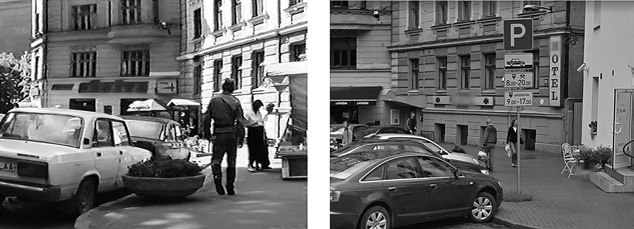
In colloquial speech, things that are strange and inexplicable are described by the expression “Nye riba, nye myaso” (from Russian, meaning “neither fish, nor meat”). For Strokins and Hanovs, this expression became a bridge leading to parts of themselves – the Russian culture and language – that, in turn, brought up the concept of hybridity. They are interested in cacophonies of meanings, because it is amid complexity that our hearing is free to pick up screams or whispers in different voices, including the voice of the past.
Layers of the past and the present are easy to observe in the urban environment. For example, when one returns to a part of a city after an absence of a few months, it’s possible to encounter it in an entirely different guise – shops and salons may have opened and closed, advertising signs are in ceaseless movement. In the nineties, such changes were particularly visible. The Soviet past was gradually “closed” and the once-stolen and forbidden past of the Latvian state “opened”. Suddenly finding themselves behind a topographic looking glass, city dwellers became confused, lost their way and went astray. They were afflicted by urban schizophrenia. Today, the imprints of past generations on now-cancelled maps are among the only remnants of the chaos of those times, along with some video material and a conversation between a father and a son on the background of the changing city.
strokins.info