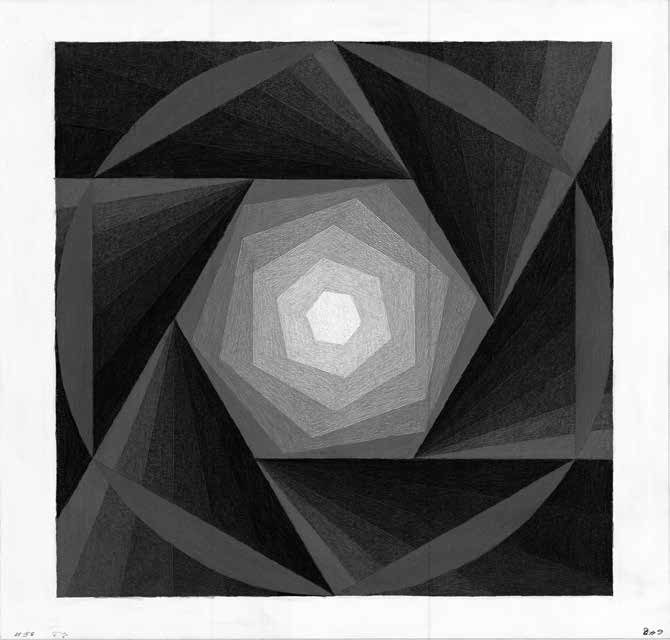
Drawings
Bristol paper, colour pencils. 1977-1988
National Archives of Latvia
In the course of his lifetime, Waldheims created more than 600 drawings and 50 small-scale sculptures; he also carried out innumerable studies, which he visualised with geometric system plans. The drawings were made in the style of geometric abstraction and in line with the artist’s theory. Initially, in order to illustrate the ideas of various important authors, Waldheims made maps and drawings. Over time, he added colour and enlarged this oeuvre by creating works of art that resembled complicated systems. When working with colour pencils, Waldheims masterfully combined tone values in each work, often providing a variety of subtle hues resulting from merely one colour.
Each drawing is based on the system of geometrisation, which, in turn, is grounded in the concept of compromise in human relationships. According to Waldheims’ theory, the human mind can be described with the help of three concepts, which are also revealed in his drawings: the extensive, which in his works corresponds to a square; the intensive, which is illustrated by a dot; and the integral, which is symbolically visualised in the shape of a rhombus or diamond. The intellectual maps made in geometric shapes attest to Waldheims’ attempts to understand the human mind.
Artist's Bio:
Zanis Waldheims (1909–1993) was an artist and philosopher of Latvian origin who fled Latvia as a refugee during World War II. At first, he migrated to Western Europe, but in 1952 he moved to Canada. In order to understand the interaction between the mind, emotions and actions, Waldheims actively studied philosophy, psychology and science. Being a dedicated researcher, he elaborated a special theory and system of geometrisation, which was reflected in his drawings. In 1974 he met Yves Jeanson, and under his initiative Waldheims exhibited for the first time ever. In 1985 Waldheims started studying in the Faculty of Philosophy at the University of Quebec, and in 1987 he prepared a 50-page paper, in which he sorted out his concepts to generalise them even more and provided an explanation in 23 particular figures of how to understand his geometrical abstraction.